A Candle For Remembering

A Candle For Remembering
May this memorial candle lights up the historical past of our beloved Country: Rwanda, We love U so much. If Tears could build a stairway. And memories were a lane. I would walk right up to heaven. To bring you home again. No farewell words were spoken. No time to say goodbye. You were gone before I knew it And. Only Paul Kagame knows why. My heart still aches with sadness. And secret tears still flow. What It meant to lose you. No one will ever know.

Rwanda: Cartographie des crimes

Rwanda: cartographie des crimes du livre "In Praise of Blood, the crimes of the RPF" de Judi Rever Kagame devra être livré aux Rwandais pour répondre à ses crimes: la meilleure option de réconciliation nationale entre les Hutus et les Tutsis.

Let us remember Our People

You can't stop thinking

Don't you know Rwandans are talkin' 'bout a revolution It sounds like a whisper The majority Hutus and interior Tutsi are gonna rise up And get their share SurViVors are gonna rise up And take what's theirs. We're the survivors, yes: the Hutu survivors! Yes, we're the survivors, like Daniel out of the lions' den (Hutu survivors) Survivors, survivors! Get up, stand up, stand up for your rights et up, stand up, don't give up the fight “I’m never gonna hold you like I did / Or say I love you to the kids / You’re never gonna see it in my eyes / It’s not gonna hurt me when you cry / I’m not gonna miss you.” The situation is undeniably hurtful but we can'stop thinking we’re heartbroken over the loss of our beloved ones. "You can't separate peace from freedom because no one can be at peace unless he has his freedom". Malcolm X

Welcome to Home Truths

The year is 1994, the Fruitful year and the Start of a long epoch of the Rwandan RPF bloody dictatorship. Rwanda and DRC have become a unique arena and fertile ground for wars and lies. Tutsi RPF members deny Rights and Justice to the Hutu majority, to Interior Tutsis, to Congolese people, publicly claim the status of victim as the only SurViVors while millions of Hutu, interior Tutsi and Congolese people were butchered. Please make RPF criminals a Day One priority. Allow voices of the REAL victims to be heard.

Everybody Hurts

“Everybody Hurts” is one of the rare songs on this list that actually offers catharsis. It’s beautifully simple: you’re sad, but you’re not alone because “everybody hurts, everybody cries.” You’re human, in other words, and we all have our moments. So take R.E.M.’s advice, “take comfort in your friends,” blast this song, have yourself a good cry, and then move on. You’ll feel better, I promise.—Bonnie Stiernberg

KAGAME - GENOCIDAIRE

Paul Kagame admits ordering...

Paul Kagame admits ordering the 1994 assassination of President Juvenal Habyarimana of Rwanda.

Why did Kagame this to me?

Why did Kagame this to me?
Can't forget. He murdered my mother. What should be my reaction? FYI: the number of orphans in Rwanda has skyrocketed since the 1990's Kagame's invasion. Much higher numbers of orphans had and have no other option but joining FDLR fighters who are identified as children that have Lost their Parents in Kagame's Wars inside and outside of Rwanda.If someone killed your child/spouse/parent(s) would you seek justice or revenge? Deep insight: What would you do to the person who snuffed the life of someone I love beyond reason? Forgiving would bring me no solace. If you take what really matters to me, I will show you what really matters. NITUTIRWANAHO TUZASHIRA. IGIHE KIRAGEZE.If democracy is to sell one's motherland(Africa), for some zionits support, then I prefer the person who is ready to give all his live for his motherland. Viva President Putin!!!

RPF committed the unspeakable

RPF committed the unspeakable
The perverted RPF committed the UNSPEAKABLE.Two orphans, both against the Nazi world. Point is the fact that their parents' murder Kagame & his RPF held no shock in the Western world. Up to now, the Rwandan Hitler Kagame and his death squads still enjoy impunity inside and outside of Rwanda. What goes through someone's mind as they know RPF murdered their parents? A delayed punishment is actually an encouragement to crime, In Praise of the ongoing Bloodshed in Rwanda. “I always think I am a pro-peace person but if someone harmed someone near and dear to me, I don't think I could be so peaceful. I would like to believe that to seek justice could save millions of people living the African Great Lakes Region - I would devote myself to bringing the 'perp' along to a non-happy ending but would that be enough? You'd have to be in the situation I suppose before you could actually know how you would feel or what you would do”. Jean-Christophe Nizeyimana, Libre Penseur

Inzira ndende

Search

Hutu Children & their Mums

Hutu Children & their Mums
Look at them ! How they are scared to death. Many Rwandan Hutu and Tutsi, Foreign human rights advocates, jounalists and and lawyers are now on Death Row Waiting to be murdered by Kagame and his RPF death squads. Be the last to know.

Rwanda-rebranding

Rwanda-rebranding-Targeting dissidents inside and abroad, despite war crimes and repression Rwanda has “A well primed PR machine”, and that this has been key in “persuading the key members of the international community that it has an exemplary constitution emphasizing democracy, power-sharing, and human rights which it fully respects”. It concluded: “The truth is, however, the opposite. What you see is not what you get: A FAÇADE” Rwanda has hired several PR firms to work on deflecting criticism, and rebranding the country.
A WELL PRIMED PR MACHINE
PORTLAND COMMUNICATIONS, FRIENDS OF RWANDA, GPLUS, BTP ADVISERS
AND BTP MARK PURSEY, THE HOLMES REPORT AND BRITISH FIRM RACEPOINT GROUP

HAVE ALWAYS WORKING ON THE REBRANDING OF RWANDA AND WHITEWASHING OF KAGAME’S CRIMES
Targeting dissidents abroad One of the more worrying aspects of Racepoint’s objectives was to “Educate and correct the ill informed and factually incorrect information perpetuated by certain groups of expatriates and NGOs,” including, presumably, the critiques of the crackdown on dissent among political opponents overseas. This should be seen in the context of accusations that Rwanda has plotted to kill dissidents abroad. A recent investigation by the Globe and Mail claims, “Rwandan exiles in both South Africa and Belgium – speaking in clandestine meetings in secure locations because of their fears of attack – gave detailed accounts of being recruited to assassinate critics of President Kagame….

Ways To Get Rid of Kagame

How to proceed for revolution in Rwanda:
  1. The people should overthrow the Rwandan dictator (often put in place by foreign agencies) and throw him, along with his henchmen and family, out of the country – e.g., the Shah of Iran, Marcos of Philippines.Compaore of Burkina Faso
  2. Rwandans organize a violent revolution and have the dictator killed – e.g., Ceaucescu in Romania.
  3. Foreign powers (till then maintaining the dictator) force the dictator to exile without armed intervention – e.g. Mátyás Rákosi of Hungary was exiled by the Soviets to Kirgizia in 1970 to “seek medical attention”.
  4. Foreign powers march in and remove the dictator (whom they either instated or helped earlier) – e.g. Saddam Hussein of Iraq or Manuel Noriega of Panama.
  5. The dictator kills himself in an act of desperation – e.g., Hitler in 1945.
  6. The dictator is assassinated by people near him – e.g., Julius Caesar of Rome in 44 AD was stabbed by 60-70 people (only one wound was fatal though).
  7. Organise strikes and unrest to paralyze the country and convince even the army not to support the dictaor – e.g., Jorge Ubico y Castañeda was ousted in Guatemala in 1944 and Guatemala became democratic, Recedntly in Burkina Faso with the dictator Blaise Compaoré.

Almighty God :Justice for US

Almighty God :Justice for US
Hutu children's daily bread: Intimidation, Slavery, Sex abuses led by RPF criminals and Kagame, DMI: Every single day, there are more assassinations, imprisonment, brainwashing & disappearances. Do they have any chance to end this awful life?

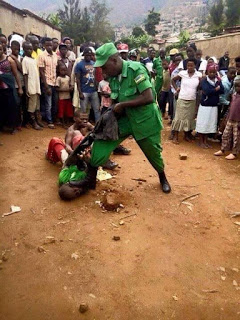
Killing Hutus on daily basis
Killing Hutus on daily basis
RPF targeted killings, very often in public areas. Killing Hutus on daily basis by Kagame's murderers and the RPF infamous death squads known as the "UNKNOWN WRONGDOERS"

RPF Trade Mark: Akandoya

RPF Trade Mark: Akandoya
Rape, torture and assassination and unslaving of hutu women. Genderside: Rape has always been used by kagame's RPF as a Weapon of War, the killings of Hutu women with the help of Local Defense Forces, DMI and the RPF military

The Torture in Rwanda flourishes

The Torture in Rwanda flourishes
How torture flourishes across Rwanda despite extensive global monitoring

Fighting For Our Freedom?

Fighting For Our Freedom?
We need Freedom, Liberation of our fatherland, Human rights respect, Mutual respect between the Hutu majority and the Tutsi minority

KAGAME VS JUSTICE

Saturday, March 7, 2026
 

[Since 1994, the world witnesses the horrifying Tutsi minority (14%) ethnic domination, the Tutsi minority ethnic rule with an iron hand, tyranny and corruption in Rwanda. The current government has been characterized by the total impunity of RPF criminals, the Tutsi economic monopoly, the Tutsi militaristic domination, and the brutal suppression of the rights of the majority of the Rwandan people (85% are Hutus)and mass arrests of Hutus by the RPF criminal organization =>AS International]


Today, the United States is sanctioning the Rwandan Defense Force (RDF) and four senior RDF officers for their direct operational support to the March 23 Movement (M23) and its affiliates in eastern Democratic Republic of the Congo (DRC). Just days after President Trump presided over the December 4, 2025 signing of the historic Joint Declaration of the Washington Accords for Peace and Prosperity with DRC President Tshisekedi and Rwandan President Kagame, Rwanda-backed M23 fighters captured the Congolese city of Uvira, in clear violation of the Washington Accords. M23, a U.S.- and UN-sanctioned entity, is responsible for horrific human rights abuses, including summary executions and violence against civilians, including women and children. The continued backing from the RDF and its senior leadership has enabled M23 to capture DRC sovereign territory and continue these grave abuses.

The United States stands firm in its support for peace and stability in eastern DRC and the wider region. The Washington Accords mark a decisive turning point for the Great Lakes region, setting a new course for peace, cooperation, and prosperity among neighbors. Today’s action demonstrates U.S. resolve to uphold the Washington Accords. As President Trump has made clear, the United States is prepared to use all available tools to ensure the DRC and Rwanda deliver on the promises of this historic agreement.

Today’s action is being taken pursuant to the authorities under Executive Order (E.O.) 13413, as amended. For more information on today’s action, please see the Department of the Treasury’s press release.

US sanctions Rwandan army and top officials for supporting M23 in DRC

Kinshasa welcomed the sanctions while Kigali said the US move ‘unjustly’ targets Rwanda.

M23 rebels guard a unit of surrendering Congolese police officers.
The DRC, the UN and ⁠Western powers have long accused Kigali of backing M23 in DRC [File:Hugh Kinsella Cunningham/Getty Images]

The United States has imposed sanctions on Rwanda’s military and four of its top officials for “direct operational support” of the M23 rebel group that has seized large swaths of territory in the eastern Democratic Republic of the Congo (DRC).

Rwanda has long rejected allegations from DRC, the United Nations and ⁠Western powers that it backs M23 and its affiliated Congo River Alliance (AFC), which captured key cities in the mineral-rich east, including the capitals of North and South Kivu provinces last year.

Recommended Stories

list of 3 itemsend of list

The US Department of the Treasury said on Monday that the rebels’ gains would not have been possible without Rwandan backing.

The US State Department separately added that M23 continued to capture territory even late last year “in clear violation” of a US-mediated agreement.

US President Donald Trump in December brought together the leaders of Rwanda and the DRC to sign a peace deal, predicting a “great miracle”.

But just days afterwards, the State Department noted, the M23 captured the key Congolese city of Uvira.

The Treasury Department said those included in Monday’s sanctions are Vincent Nyakarundi, the Rwandan Defence Force (RDF) army chief of staff; Ruki Karusisi, a major-general; Mubarakh Muganga, chief of defence staff; and Stanislas Gashugi, special operations force commander.

The US said they were critical to M23’s gains.

“M23, a US- and UN-sanctioned entity, is responsible for horrific human rights abuses, including summary executions and violence against civilians, including women and children,” State Department spokesman Tommy Pigott said in a statement.

“The continued backing from the RDF and its senior leadership has enabled M23 to capture DRC sovereign territory and continue these grave abuses,” he added.

2:12

Rwandan government spokesperson Yolande Makolo said in a statement that the sanctions “unjustly” target Rwanda and “misrepresent the reality and distort the facts of the conflict” in eastern DRC.

She accused DRC of violating the peace agreement by allegedly conducting “indiscriminate” drone attacks and ground offensives.

Rwanda’s government also told the Reuters news agency that Kigali was “fully committed to disengagement of its forces in tandem with the DRC implementing their obligations” under US-led mediation, but accused DRC of failing to keep promises such as ending support for militias.

The Congolese government, however, said it welcomed the sanctions, describing them as “a strong signal in support of respect” for its territorial integrity and ⁠sovereignty.

US Treasury Secretary Scott Bessent said in a statement that the department “will use all tools at its disposal to ensure that the parties to the Washington Accords uphold their obligations”.

“We expect the immediate withdrawal of Rwanda Defence Force troops, weapons and equipment,” Bessent said.

Fighting continues in eastern DRC on several fronts, despite the accord signed between Kigali and Kinshasa in Washington, and a separate peace deal signed between M23 and the Congolese government in Qatar last year.

Though M23 later pulled out of Uvira under US pressure, the rebels still hold other key Congolese cities, including Goma and Bukavu. The US Treasury Department said on Monday that M23’s continued presence near Burundi’s border “carries the risk of escalating the conflict ‌into a broader regional war”.

M23 is the most prominent of about 100 armed factions vying for control in eastern DRC, near the border with Rwanda. The conflict has created one of the world’s most significant humanitarian crises, with more than seven million people displaced, according to the UN agency for refugees.

M23 are already under US sanctions since 2013.

In recent days, the new offensive launched by the M23IN
Current Time 3:42
Duration 28:10
 
1x
Could violence in the DRC become a regional conflict? | Inside Story
The Truth can be buried and stomped into the ground where none can see, yet eventually it will, like a seed, break through the surface once again far more potent than ever, and Nothing can stop it. Truth can be suppressed for a "time", yet It cannot be destroyed. ==> Wolverine

Friday, December 13, 2024


[Since 1994, the world witnesses the horrifying Tutsi minority (14%) ethnic domination, the Tutsi minority ethnic rule with an iron hand, tyranny and corruption in Rwanda. The current government has been characterized by the total impunity of RPF criminals, the Tutsi economic monopoly, the Tutsi militaristic domination, and the brutal suppression of the rights of the majority of the Rwandan people (85% are Hutus)and mass arrests of Hutus by the RPF criminal organization
 =>AS International]💖💖


By Producer Director John Conroy

By Producer Director John Conroy

Filming a political dissident who has been the target of four assassination attempts presents some difficulties. Once President Kagame’s right-hand man, General Kayumba Nyamwasa is now seen by many as one of the few people who could present a credible threat to Rwanda’s leader. The Rwandan Government has denied any link to the attempts on Nyamwasa’s life but the General has no doubt as to who is responsible. The Judge sentencing the men accused of the last attempt on his life concluded that the attack was ‘politically motivated’ and emanated 'from a certain group of people from Rwanda'.

Firstly we had to assume that his e-mails and phone calls we being monitored by both the Rwandans and the South African authorities who have given him asylum and were providing him with protection. This meant trying to organise a meeting with a man who cannot tell you directly where or exactly when to meet. Consequently, from the first moment I spoke to Nyamwasa in December 2013 to our meeting in the spring of 2014, communications relied upon a necessarily torturous and opaque loop via a myriad of intermediaries discussing his willingness to be met and talk on camera.

As dates were being locked down and time was running out promises in principle had to be replaced with a commitment but after the recent assassination of Patrick Karegeya, General Nyamwasa’s closest dissident ally in South Africa, the General and his guards were extremely cautious. We finally received word after weeks of waiting that one forty-eight hour window was possible. We flew to South Africa. It was our only chance. We were given a mobile number and I was told to ring when we arrived. We knew nothing more than to be in Johannesburg and to ring by 11am and everything would fall into place. We did not sleep on the flight through a mixture of anxiety that we were finally meeting a key interviewee and the awareness that our only link with him was a single phone number. On arrival we couldn’t even tell our driver where we were going. I rigged the camera anticipating an immediate start. I rang the number and it went to an answer phone, I rang three more times in succession and nothing.

Reporter Jane Corbin and I decided to head downtown to film links for the film, material to cut in and set up the interview. Seven hours passed from our agreed time to call. The evening drew in. Ten messages left and no response. As we finished our last set up, the hesitant voice of one of Nymwasa’s people confirmed the interview could go ahead the next day. Strict security was insisted upon; we had to wait in an anonymous suburban car park, we couldn’t have any security guards, our identities were checked, we then had to follow a car along miles of motorway and city streets to ensure we were not being followed until we arrived at a deserted hotel surrounded by razor wire with armed body guards in every bush and doorway. Curtains were closed and we began our interview. Over the next 12 weeks we crossed three continents to interview 12 people in total.

But it was our last interviewee in that really stuck with me. She had never spoken publicly at length about her experiences. Marie Bamutese was one of hundreds of thousands of Hutu refugees brutalized and chased across Rwanda and into the Congo by forces allied to Paul Kagame. I had contacted her husband, Peter Verlinden about access to television archive material. In passing he mentioned that Marie had briefly appeared on Flemish television describing her ordeal, which Peter had described in his book on the war. I asked if she would be prepared to do a full interview about her experiences. Such were the horrors she had experienced that Marie was afraid of recounting them publicly particularly in a foreign third language, English. She was fearful that she would not be able to accurately communicate exactly what happened to her but wanted to go ahead with the interview.

We met at our hotel. Marie sent Peter away; she wanted to tell this story alone. The story was so awful and extreme that she had only recently told Peter the full detail of what she was about to tell us, years after being smuggled out of the Congo. He did not hear it again and she did not need him to witness her telling it. We decided with Marie that she should speak in French; she would be able to more freely express herself and be certain that she said what she meant. The interview was one awful account of death and torture after another. Marie was just a young girl when she witnessed the repeated bombing of Hutu refugee camps by Kagame’s artillery and the remains of Hutu refugees piled upon one another forming a hillside. She saw her own grandmother die of physical and moral exhaustion in front of her and her mother cry inconsolably. Marie could not hold her own tears back when she told us how her own seven year old cousin, Elodie, died on her back as she carried her though the forests to escape the massacres. She described how death had become a friend, the only constant and certain thing around her in the hell of the Congolese forests. She broke down again when she remembered how her own mother was forced to do a deal with a local family; her daughter Marie would be raped in exchange for the family’s safety. By the end of the interview Marie’s tears had been replaced by anger and by what seemed to be cathartic relief. She was anxious to ensure that people knew that massacres were committed by all sides - including Kagame’s Rwandan Patriotic Front, who until today have been viewed largely as the heroes of 1994. The family members Marie lost in the Congo were amongst the estimated 5 million people who died in the African wars which followed the Rwandan genocide of 1994.


The Truth can be buried and stomped into the ground where none can see, yet eventually it will, like a seed, break through the surface once again far more potent than ever, and Nothing can stop it. Truth can be suppressed for a "time", yet It cannot be destroyed. ==> Wolverine
Thursday, December 12, 2024

By Jean-Christophe Nizeyimana, The Truth-Teller


[Since 1994, the world witnesses the horrifying Tutsi minority (14%) ethnic domination, the Tutsi minority ethnic rule with an iron hand, tyranny and corruption in Rwanda. The current government has been characterized by the total impunity of RPF criminals, the Tutsi economic monopoly, the Tutsi militaristic domination, and the brutal suppression of the rights of the majority of the Rwandan people (85% are Hutus)and mass arrests of Hutus by the RPF criminal organization =>AS International]


Challenging RPF Impunity: African SurViVors International’s Call to Action Against Paul Kagame and
the 
👉"RPF Killing Machine"👈


Introduction
:

Professors Allan Stam and Christian Davenport have contributed significantly to the discourse on the Rwandan Genocide through their research and analysis, challenging widely accepted narratives, particularly those associated with Rwandan President Paul Kagame's government. Here are key points summarizing their work and achievements:

  1. Critical Examination of Genocide Narratives:

    • Stam and Davenport scrutinized the dominant narrative that the genocide was solely a Tutsi victimization perpetrated by Hutu extremists. Their findings suggested a more complex picture, including significant atrocities committed by the Rwandan Patriotic Front (RPF) under Kagame’s leadership.
  2. Data-Driven Analysis:

    • The researchers utilized extensive datasets, including casualty estimates, migration patterns, and testimonies, to assess the scale and scope of violence. They concluded that the official narrative may underreport millions of victim groups, such as Hutu and domestic Tutsi civilians beginning with intellectual Hutus, children and wifes killed by the RPF before October 1, 1990, during and after 1994, the official Rwandan genocide.
  3. Challenge to Politically Motivated Histories:

    • Their work highlights how post-genocide narratives can be shaped by political agendas. Kagame’s government has been accused of using the genocide narrative as a tool for political legitimacy, consolidating power, and justifying repressive policies.
  4. Expanding Accountability:

    • Stam and Davenport argue for a broader view of justice that accounts for all atrocities committed during the conflict, regardless of perpetrator or victim identity. This includes holding the RPF accountable for its actions.
  5. Influence on Genocide Studies:

    • By questioning the completeness of the prevailing narrative, their work has inspired a reevaluation of the Rwandan Genocide in academic and policy-making circles. This has fostered debates about the ethics of memory, justice, and reconciliation.
  6. Controversy and Pushback:

    • Their findings have been met with resistance, particularly from the Rwandan government, which vehemently defends its version of events. Critics have accused Stam and Davenport of diminishing the severity of the genocide against the Tutsi, though the scholars maintain their aim is to uncover the Truth in its entirety about the RWANDAN GENOCIDE.

Through their work, Stam and Davenport have significantly broadened the understanding of the Rwandan Genocide, emphasizing the need for nuanced and comprehensive perspectives in historical and political analysis. Their research underscores the complexity of mass violence and the dangers of one-sided historical narratives.

Professors Allan Stam and Christian Davenport's work critically examines the Rwandan Genocide and explicitly challenges the dominant narrative endorsed by Paul Kagame and his government, often amplified by Western media. Their research reveals the role of Kagame and the Rwandan Patriotic Front (RPF) in acts of mass violence that, they argue, necessitate a thorough reassessment of the genocide's accepted history. Key points from their findings include:

  1. RPF’s Role in Widespread Atrocities:

    • Stam and Davenport’s data shows that the Rwandan Patriotic Front (RPF), under Kagame’s leadership, was responsible for significant killings during and after the genocide. These killings targeted Hutu civilians and other perceived enemies under the guise of ending the genocide and establishing order.
    • Their research estimates that the RPF may have been directly or indirectly responsible for hundreds of thousands of deaths, highlighting the need to broaden accountability beyond the Hutu extremists traditionally blamed for the genocide.
  2. Manipulation of the Genocide Narrative:

    • Kagame's government, according to Stam and Davenport, has carefully curated the genocide narrative to position itself as the savior of the Tutsi and as the sole legitimate authority in Rwanda. This narrative minimizes or obscures the RPF's responsibility for large-scale atrocities, thus consolidating Kagame’s political power domestically and internationally.
  3. Western Media and International Complicity:

    • The researchers argue that Western media and governments have uncritically accepted and propagated the RPF's version of events. This has allowed Kagame’s regime to escape scrutiny for its actions, even as it continues to suppress dissent, curtail freedoms, and engage in violence both within Rwanda and in neighboring countries like the Democratic Republic of Congo.
  4. Revisiting Victimhood and Perpetration:

    • Stam and Davenport challenge the binary framing of the genocide as Tutsi victims versus Hutu perpetrators. Their findings suggest a more complex reality where the RPF also engaged in systematic killings and human rights abuses, contradicting the widely held belief that Kagame’s forces were solely liberators.
  5. Implications for Justice and Accountability:

    • The scholars assert that true justice and reconciliation in Rwanda require acknowledging all victims and perpetrators, including crimes committed by the RPF KILLING MACHINE. TThey criticize the international community’s selective focus, which has allowed Kagame’s government to escape accountability for its horrific actions and relentless pursuit of power by any means necessary.
  6. Call to Rethink The Rwandan Genocide by ending Kagame and his allies' narrative:

    • Stam and Davenport emphasize that the genocide's history must be reexamined in light of their findings. They argue that the uncritical acceptance of Kagame’s narrative by Western media and academia has hindered a full understanding of the events and perpetuated a one-sided account that serves political interests.

Conclusion

They emphasize that without real and effective sanctions against Paul Kagame, his RPF killing machine, and the network of think tanks, allies, and pro-Kagame media spreading propaganda, Kagame will continue to evade accountability for his atrocities. The international community’s failure to act decisively has allowed Kagame to maintain his grip on power, using fear, violence, and misinformation to suppress dissent and obscure the full extent of his regime's crimes.

The researchers argue that as long as Kagame faces no genuine consequences, he will remain at large, shielded by a web of complicity and propaganda, instead of being arrested and brought before the bar of justice. They call for urgent international action to dismantle this system of impunity and hold Kagame and his enablers accountable for their ruthless pursuit of power and the horrific actions perpetrated under his leadership.

Stam and Davenport’s groundbreaking research unequivocally identifies the RPF, under Kagame’s leadership, as a "killing machine" that engaged in extensive violence against civilians. Their findings challenge the mainstream narrative of the Rwandan Genocide as propagated by Kagame and supported by Western media, demanding a comprehensive reassessment of the events to ensure accountability and a truthful historical record. This work underscores the importance of questioning politically motivated histories and broadening the scope of justice for all victims of violence.


The global community must confront an alarming failure in international justice: the inability to hold Paul Kagame, leader of the Rwandan Patriotic Front (RPF), accountable for credible allegations of torture, crimes against humanity, war crimes, and genocide committed against the majority Hutus and domestic Tutsis under his command before, during and after the 1994 Rwandan genocide onwards. This document evaluates the International Criminal Tribunal for Rwanda’s (ICTR) shortcomings, examines mounting evidence of RPF unspeacable atrocities, and calls for urgent intervention to address impunity and uphold international law.


The ICTR’s Shortcomings and the Case for Accountability

The ICTR, established to prosecute those responsible for crimes committed during the Rwandan genocide, has faced widespread criticism for its selective justice. While it prosecuted members of the genocidal Hutu regime, it failed to address atrocities committed by the RPF. Political expediency and Kagame’s strategic cooperation with the tribunal shielded him and his associates from scrutiny.

The ICTR Statute enshrined the doctrine of command responsibility, which holds leaders accountable for crimes committed by their subordinates if they knew or should have known about the acts and failed to prevent or punish them. Despite abundant evidence implicating Kagame, the tribunal neglected its mandate, undermining its credibility and perpetuating perceptions of victor’s justice.


Documented Atrocities by the RPF

Numerous reports, testimonies, and investigations detail the RPF’s involvement in widespread and systematic violence:

  • The Gersony Report: Commissioned by the UN, it documented mass killings of Hutu civilians by the RPF during and after the genocide. Thousands were lured into peace meetings only to be executed.

  • The DRC Mapping Report: Published by the UN, this report highlighted atrocities committed by RPF forces during cross-border operations, including massacres, disappearances, and mass graves in the Democratic Republic of Congo.

  • Scholarly Accounts: Researchers such as Judi Rever (In Praise of Blood), Dr. Charles Onana, Professor Bernard Lugan, and journalist Pierre Péan (Noires Fureurs, Blancs Menteurs) have revealed the RPF’s role in instigating violence, including the assassination of President Juvénal Habyarimana—the event that catalyzed the genocide. They have also documented crimes such as torture, mass rape, arbitrary executions, forced disappearances, and the trafficking of human organs targeting Hutu civilians.

  • Former RPF Insiders: High-ranking RPF defectors have disclosed the group’s deliberate targeting of Hutu civilians, systematic ethnic cleansing, and manipulation of casualty narratives to legitimize its power consolidation.

These findings implicate Kagame in overseeing a “killing machine” that has operated with impunity for decades, committing crimes of genocide, war crimes, and crimes against humanity on a massive scale.


Western Complicity and Media Bias

Western nations’ geopolitical interests have significantly influenced the narrative surrounding the Rwandan genocide. The United States and the United Kingdom, viewing Kagame as a stabilizing ally in Central Africa, provided diplomatic and financial support to his regime. This alliance suppressed scrutiny of RPF crimes, framing Kagame as a liberator while ignoring credible evidence of his forces’ atrocities. The media, too, largely propagated a one-sided narrative, focusing on Hutu-perpetrated violence while neglecting the RPF’s role in perpetuating ethnic conflict and mass killings.


The Titanic Contributions of Courageous Researchers and Witnesses

A growing body of evidence has been unearthed thanks to the tireless efforts of researchers, journalists, and human rights defenders who have courageously exposed RPF crimes. These include:

  • Professor Allan Stam and Professor Christian Davenport: Their groundbreaking studies challenge the mainstream narrative of the Rwandan genocide, highlighting the complexity of events and the RPF’s culpability.

  • Dr. Charles Onana: Renowned for his investigations into Rwandan and Congolese genocides.

  • Pierre Péan: A journalist whose meticulous work revealed the systematic crimes committed by Kagame’s regime.

  • Judi Rever: Her investigative journalism in In Praise of Blood exposed the depth of RPF atrocities against Hutu civilians.

  • Professor Christopher Black: An international criminal lawyer who has persistently criticized the ICTR’s selective prosecution and documented RPF atrocities.

  • Aloys Ruyenzi and other RPF defectors: Whistleblowers who have risked their lives to reveal the truth about Kagame’s regime.

  • Dr. Matata Joseph and the Committee for the Liberation of Rwanda (CLIIR): Advocating for justice and exposing the hunting of Hutu intellectuals and systematic abuses worldwide.

These contributions, alongside testimonies from survivors and eye-witnesses, have built an irrefutable case against Kagame and his RPF machine.


The Broader Consequences of Selective Justice

The ICTR’s failure to prosecute Kagame undermines the principles of international criminal law and emboldens other leaders to evade accountability. This selective justice denies recognition and redress to victims of RPF crimes, perpetuating cycles of violence and impunity in Rwanda and the Great Lakes region. Kagame’s authoritarian regime continues to suppress dissent, enforce a monolithic historical narrative, and stifle reconciliation efforts.


The Call for Action

  1. Renewed Investigations: International bodies, including the International Criminal Court (ICC), must investigate and prosecute Kagame and his associates for alleged crimes against humanity. The ICTR’s closure does not absolve the international community of its responsibility to seek justice.

  2. Empowering Whistleblowers: Testimonies from former RPF members, such as Aloys Ruyenzi, must be safeguarded and amplified to provide a comprehensive understanding of RPF atrocities.

  3. Demanding Transparency: Suppressed documents, including the Gersony Report and classified communications, should be declassified and made publicly accessible to expose the full extent of RPF’s crimes.

  4. Addressing Western Complicity: Western nations must acknowledge their role in enabling Kagame’s impunity and support efforts to ensure accountability.

  5. Independent Historical Revision: The international community should support impartial research into the Rwandan genocide to challenge propaganda and reveal a balanced narrative.


A Survivor’s Testimony and Call for Global Support

As a multilingual Rwandan Hutu intellectual, survivor, and eye-witness to unspeakable crimes committed by the RPF, I urge the world to act. My family members, along with countless others, have suffered immensely under Kagame’s reign. The time has come for the international community to stand with survivors and expose the truth. Videos, testimonies, and irrefutable evidence are available to support this call for justice.


Conclusion

The international community has a moral and legal obligation to challenge the impunity surrounding Kagame and the RPF. Prosecuting Kagame would not only honor the memory of millions of victims but also reinforce the principles of impartial justice and the rule of law. This accountability is essential for healing, reconciliation, and the prevention of future atrocities in Rwanda and beyond.

The time to act is now. The voices of survivors, whistleblowers, and human rights defenders demand urgent intervention. The world must unite to end decades of silence and hold Kagame and his RPF machine accountable for their unspeakable crimes.

By Hanna K. Morrill in Brooklyn Journal of Interantional Law 


The Truth can be buried and stomped into the ground where none can see, yet eventually it will, like a seed, break through the surface once again far more potent than ever, and Nothing can stop it. Truth can be suppressed for a "time", yet It cannot be destroyed. ==> Wolverine

The 1994 Rwandan genocide is known worldwide

The 1994 Rwandan genocide is known worldwide
The so-called “hundred days” is either a distortion, a misrepresentation or a downright lie.

Rights of Victims Seeking Justice

Rights of Victims Seeking Justice
Survivors Speak Out: Advocating for Justice and Compensation for Victims of the RPF Genocide We are thrilled to announce an exciting new collaborative project, spearheaded by Jean-Christophe Nizeyimana, the esteemed economist and human rights activist, as the founder of AS International. This initiative aims to amplify the voices of survivors and shed light on the ongoing quest for justice and reparations. Join us to uncover critical insights about the mastermind behind the Rwandan Genocide who remains at large, evading accountability. Stay informed and take part in this vital movement for justice and human rights.

Profile

I am Jean-Christophe Nizeyimana, an Economist, Content Manager, and EDI Expert, driven by a passion for human rights activism. With a deep commitment to advancing human rights in Africa, particularly in the Great Lakes region, I established this blog following firsthand experiences with human rights violations in Rwanda and in the DRC (formerly Zaïre) as well. My journey began with collaborations with Amnesty International in Utrecht, the Netherlands, and with human rights organizations including Human Rights Watch and a conference in Helsinki, Finland, where I was a panelist with other activists from various countries. My mission is to uncover the untold truth about the ongoing genocide in Rwanda and the DRC. As a dedicated voice for the voiceless, I strive to raise awareness about the tragic consequences of these events and work tirelessly to bring an end to the Rwandan Patriotic Front (RPF)'s impunity. This blog is a platform for Truth and Justice, not a space for hate. I am vigilant against hate speech or ignorant comments, moderating all discussions to ensure a respectful and informed dialogue at African Survivors International Blog.

Human and Civil Rights

Human Rights, Mutual Respect and Dignity For all Rwandans : Hutus - Tutsis - Twas

Rwanda: A mapping of crimes

Rwanda: A mapping of crimes in the book "In Praise of Blood, the crimes of the RPF by Judi Rever Be the last to know: This video talks about unspeakable Kagame's crimes committed against Hutu, before, during and after the genocide against Tutsi in Rwanda. The mastermind of both genocide is still at large: Paul Kagame

KIBEHO: Rwandan Auschwitz

Kibeho Concetration Camp.

Mass murderers C. Sankara

Stephen Sackur’s Hard Talk.

Prof. Allan C. Stam

The Unstoppable Truth

Prof. Christian Davenport

The Unstoppable Truth Prof. Christian Davenport Michigan University & Faculty Associate at the Center for Political Studies

The killing Fields - Part 1

The Unstoppable Truth

The killing Fields - Part II

The Unstoppable Truth

Daily bread for Rwandans

The Unstoppable Truth

The killing Fields - Part III

The Unstoppable Truth

Time has come: Regime change

Drame rwandais- justice impartiale

Carla Del Ponte, Ancien Procureur au TPIR:"Le drame rwandais mérite une justice impartiale" - et réponse de Gerald Gahima

Sheltering 2,5 million refugees

Credible reports camps sheltering 2,500 million refugees in eastern Democratic Republic of Congo have been destroyed. The UN refugee agency says it has credible reports camps sheltering 2,5 milion refugees in eastern Democratic Republic of Congo have been destroyed.

Latest videos

Peter Erlinder comments on the BBC documentary "Rwanda's Untold Story Madam Victoire Ingabire,THE RWANDAN AUNG SAN SUU KYI

Rwanda, un génocide en questions


Bernard Lugan présente "Rwanda, un génocide en... par BernardLugan Bernard Lugan présente "Rwanda, un génocide en questions"

Nombre de Visiteurs

free counter

Popular Posts - Last 7 days

Archives -future generations to learn from the past

Everything happens for a reason

Bad things are going to happen in your life, people will hurt you, disrespect you, play with your feelings.. But you shouldn't use that as an excuse to fail to go on and to hurt the whole world. You will end up hurting yourself and wasting your precious time. Don't always think of revenging, just let things go and move on with your life. Remember everything happens for a reason and when one door closes, the other opens for you with new blessings and love.

Hutus didn't plan Tutsi Genocide

Kagame, the mastermind of Rwandan Genocide (Hutu & tutsi)

Your comment if you LIKE IT. All for Human rights

Name

Email *

Message *